Newsroom
At Auberle, amazing things happen every day. Visit our Newsroom to find announcements, press releases,media coverage, achievements and awards, expert content from our highly skilled team members, and more.
Auberle Board Chair Dr. Sundeep Ekbote Presents at TEDx Sewickley Academy Youth: "Giving Back: How Service Shapes our Community"
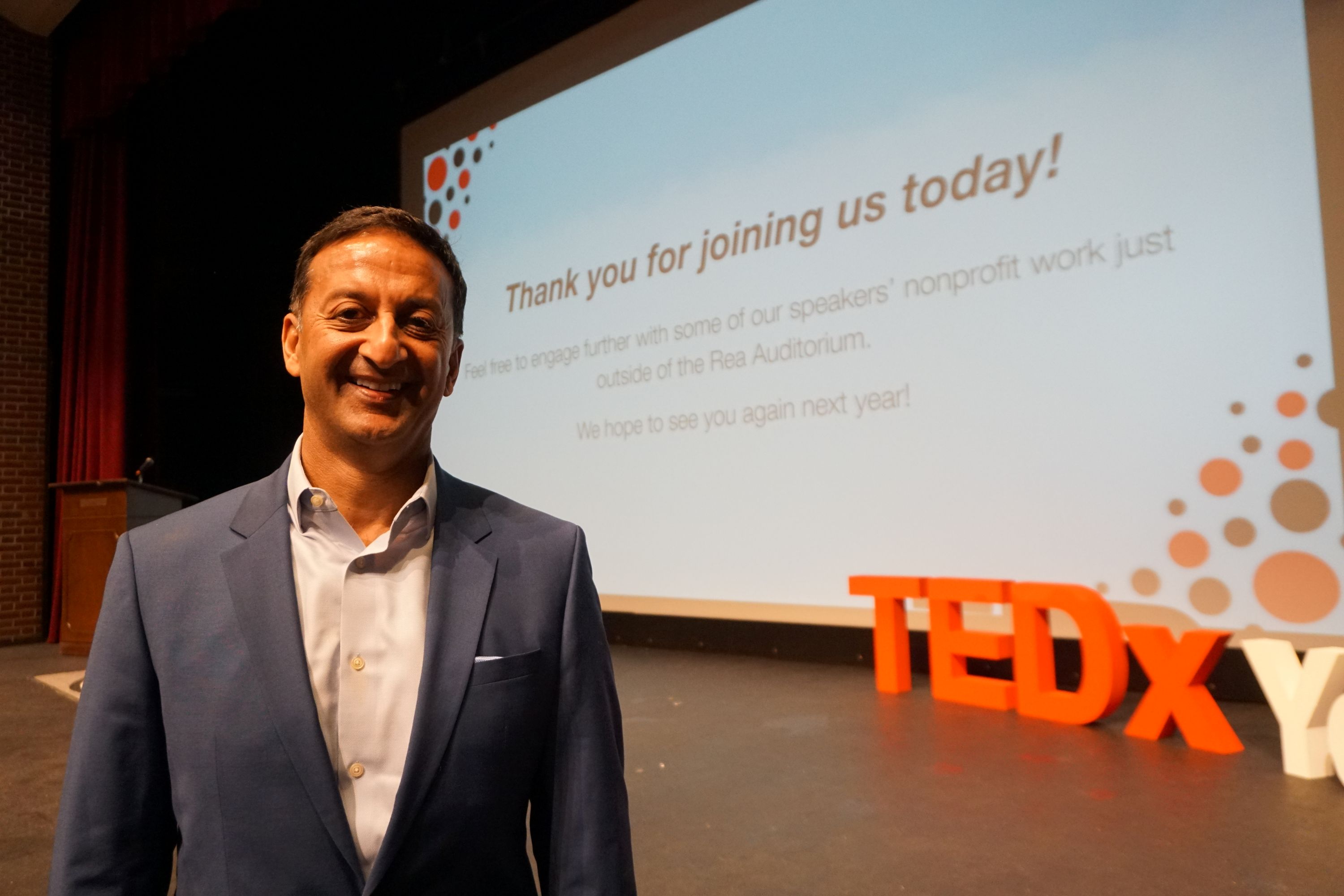
Sewickley, PA, April 2026 — Auberle Board Chair, Dr. Sundeep Ekbote, at Sewickley Academy after his TEDx Talk on Auberle.
In his powerful TEDx talk, Dr. Sundeep Ekbote shares a frontline story of a teen in crisis to reveal a deeper truth: while emergency medicine can save a life in the moment, lasting healing happens through community. That's when organizations like Auberle step in to provide resources, stability, and a path forward.
Dr. Sundeep Ekbote TEDx Transcript from April 11, 2026:
It really is an honor to be here and a privilege to hear some fantastic stories. I'm really proud to be able to speak to you about my career in emergency medicine and how it helps me shape my community. Let me start by telling you a story.Auberle brings life to the young people it serves. They've also brightened my outlook as well. They've given me a greater amount of faith that there are people ready to serve and take care of others. Emergency medicine can stabilize your life for today, but service can give you long term support for the future.
Chelsea is 17 years old. She comes from a good family. She lives in a nice neighborhood. Her parents are professionals. Chelsea gets good grades. Chelsea has plans. She's getting ready for college. University is just around the corner. Life is perfect. Unfortunately, Chelsea harbors a deep secret, one she may never share. One night, she's brought to the emergency department by her boyfriend. She's quiet and withdrawn. She's sitting on the edge of the stretcher. Her shoulders are stooped; her eyes are fixated on the floor as tears well up in her eyes. She curls over into a fetal position on the bed and breaks out in tears.
She confesses that she's been very depressed and thinking about hurting herself. In fact, she showed me her left arm where she had cut it earlier that day with a dirty old box cutter. The laceration wasn't fatal, but it was deliberate and intentional. It showed that she had been thinking about this for a long time.

Sewickley, PA, April 2026 - Dr. Sundeep Ekbote presents to community leaders, students, and educators at Sewickley Academy.
Like so many adolescents, taking care of her in the emergency department was going to be a challenge. Inpatient beds for mental health care were in short supply and were very often full. Outpatient Care is often delayed by days or weeks. I found this very frustrating taking care of her. In emergency medicine, I have an opportunity to take care of people in their moments of greatest need. Sometimes the moment is small, a laceration that requires sutures, simple and straightforward. Sometimes it's a bit more interesting, a broken bone or a dislocated joint that needs to be put back into place. At times, it can be even more dramatic. If a person with a stroke comes in early enough, we're able to give them a clot busting medicine and give them back their movement or their life.
I reached out to a friend of mine, an attorney who's deeply involved in our community, and I shared with him what I was seeing: kids in crisis every day. Treatment options were limited. I thought, "We need to do something about this."
Emergency medicine is very often service to people, but also it is service to people in their moments of greatest vulnerability. Taking care of Chelsea was a little bit different. Yes, I could stitch her wound up, wash it out, put bandage on it. I could even give her a prescription for antibiotics. However, getting her to proper mental health care is often challenging, particularly for underage people. Access to health care for adolescents in mental health is very difficult. So, I became very frustrated, and I started looking for options.
I reached out to a friend of mine, an attorney who's deeply involved in our community, and I shared with him what I was seeing: kids in crisis every day. Treatment options were limited. I thought we needed to do something about this. The data supports what we clinicians are seeing: the CDC showed in a survey from 2009 to 2021 that feelings of hopelessness and sadness among adolescents increased by 40%. 20% of teenagers will experience a serious depressive episode before reaching adulthood. Worse yet, teenage girls experience depression at twice the rate of boys.


Presenters included students, professors, and community leaders working both locally and globally.
Access to mental health care is limited. In the United States, there's only one child psychiatrist for every 35,000 children, and 50% of children and teenagers often don't get mental health care that they need. Frankly, the outlook sometimes seems very bleak. Every year it seems like we have a government shutdown that threatens mental health funding. Budgetary decisions always seem to put funding for mental health care at risk. So, I thought about my options. I reached out to an attorney friend of mine, and I said, "We need to do something about this." I'm seeing kids every day, kids in crisis and nowhere to go, no safe place to land. The system is failing us. The system is failing our children. You're an attorney. I'm a physician. I'm no NFL quarterback or tech millionaire, but maybe let's get together, and we can put together a foundation that can support and provide some social service for our young people.
That's when I learned about Auberle, a cutting-edge human service program that provides assistance to youth in their moments of greatest need. They are able to provide housing support, young adult services, foster care, and even have an Employment Institute, because for a child suffering through neglect, consistency is key.
That's when he smiled and looked at me and said, "Sundeep, you don't need to start a foundation. You need to join one." That's when I learned about Auberle, a cutting-edge human service program that provides assistance to youth in their moments of greatest need. They are able to provide housing support, young adult services, foster care, and even have an Employment Institute, because for a child suffering through neglect, consistency is key. Treatment for a child aging out of foster care and mentorship at the Employment Institute can be the difference between independence and lifelong instability, and most relevant to our case today: mental health services. Auberle is able to provide outpatient mental health care and even telemedicine and telepsychiatry.
So, back to her story about Chelsea. I was able to suture her wound, give her a bandage and a dressing, but she did wait in the ED for over a day. Eventually, we were able to get her connected with outpatient mental health support and get her connected with therapy.
Emergency medicine stabilized her medical conditions, but community service is what provided her support in the long run. Weeks later, we found out that she was still in therapy, but she had returned to school and was safe.
Auberle brings light to people on their darkest days. Auberle is able to provide care to our young people in their moments of greatest need and provide long-term support. As much as Auberle brings life to the young people it serves, they've also brightened my outlook as well. They've given me a greater amount of faith that there are people ready to serve and take care of others. Emergency medicine can stabilize your life for today, but service can give you long term support for the future. Thank you.

Thank you to Sewickley Academy for the opportunity to present. Learn more at www.sewickley.org
Connect with us!
www.auberle.org
www.instagram.org/auberleofficial
www.facebook.com/Auberle.McKeesport
www.linkedin.com/company/auberle